Fire Extinguisher Recharge in San Leandro, CA: When to Refill, Inspect, or Replace Your Extinguishers
Need fire extinguisher recharge service in San Leandro, CA? If a rechargeable fire extinguisher has been used, even briefly, it generally needs professional servicing and recharging before being returned to service. Acme Fire Extinguisher Co. provides portable fire extinguisher recharging, refilling, inspection, testing, and maintenance for businesses and property owners throughout San Leandro and surrounding Alameda County communities.
With an established service facility in Oakland and mobile fire extinguisher service available throughout the area, Acme helps customers maintain fire protection equipment and determine when an extinguisher should be recharged, repaired, or replaced.
Learn more about Acme Fire Extinguisher Co.’s recharging and maintenance services or call (510) 532-4040 to discuss your equipment.
Where Can You Get a Fire Extinguisher Recharged in San Leandro?
San Leandro businesses, apartment managers, industrial facilities, and other property owners can contact Acme Fire Extinguisher Co. for portable fire extinguisher recharging and related maintenance.
Acme operates from 1305 Fruitvale Avenue in Oakland and advertises mobile service throughout Alameda and Contra Costa counties, including San Leandro.
Customers may arrange on-site service or inquire about bringing their equipment to the Oakland facility.
Not every fire extinguisher can be recharged. The appropriate service depends on the extinguisher’s construction, condition, age, labeling, and applicable maintenance requirements.
What Does Fire Extinguisher Recharging Mean?
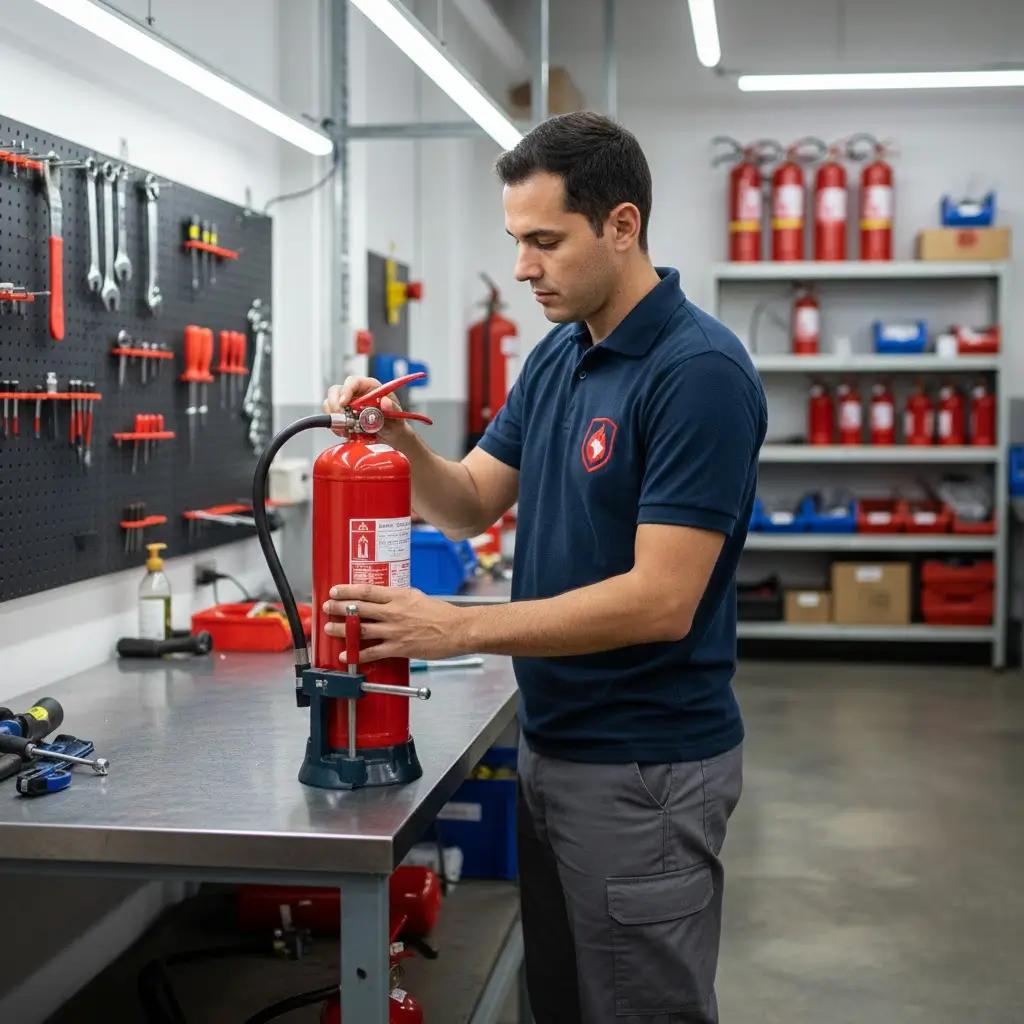
Fire extinguisher recharging is the professional process of restoring a suitable rechargeable extinguisher to its required operating condition after discharge or when servicing determines that recharging is necessary.
Depending on the extinguisher design and service requirements, the process may involve removing remaining extinguishing agent, inspecting components, replacing specified parts, refilling the proper agent, restoring pressure, checking for leaks, and documenting the work.
These procedures should be performed by qualified personnel using the manufacturer’s instructions and appropriate equipment.
Simply adding pressure to an extinguisher does not necessarily make it safe or ready for use.
When Does a Fire Extinguisher Need to Be Recharged?
Several conditions may indicate that an extinguisher needs professional attention.
1. After Any Discharge
A rechargeable extinguisher should be professionally serviced after use, even if only a small amount of agent was released.
Partial discharge can reduce available extinguishing agent or affect pressure and sealing components.
2. When the Pressure Indicator Is Outside Its Acceptable Range
On extinguishers equipped with pressure gauges, a reading outside the manufacturer’s specified operating range may indicate a problem.
Not all extinguisher types use pressure gauges, and a normal gauge reading does not prove that an extinguisher is fully serviceable.
3. When an Inspection Identifies a Problem
A professional inspection may identify leakage, damaged components, missing seals, or other conditions requiring maintenance.
Depending on the findings, recharging, repair, testing, or replacement may be appropriate.
4. During Certain Maintenance Procedures
Some internal maintenance or testing procedures require the extinguisher to be discharged, emptied, or otherwise serviced before being returned to use.
Recharging may be part of that process.
5. When the Extinguisher Has Lost Agent or Pressure
Unexplained pressure loss or suspected leakage should be investigated rather than corrected through an improvised refill.
The underlying cause must be addressed before the equipment is placed back into service.
Can Every Fire Extinguisher Be Refilled?
No. Some fire extinguishers are rechargeable, while others are designed for one-time use.
Rechargeable extinguishers are manufactured to permit specified maintenance and refilling procedures.
Non-rechargeable or disposable extinguishers generally must be replaced after use or when they are no longer serviceable.
Even a rechargeable extinguisher may require replacement if its cylinder, valve, or other critical components are damaged or if it fails required testing.
Acme Fire Extinguisher Co. provides both recharging and replacement services, allowing customers to discuss the appropriate option for their equipment.
Fire Extinguisher Recharge Versus Replacement
Recharging and replacing an extinguisher accomplish different things.
Recharging restores a serviceable rechargeable extinguisher according to its approved servicing requirements.
Replacement provides a different extinguisher when the existing unit is unsuitable, damaged, obsolete, non-rechargeable, or otherwise not worth servicing.
Consider these questions:
- Is the extinguisher labeled as rechargeable?
- Is the cylinder in acceptable condition?
- Are the valve and other components serviceable?
- Does the unit require hydrostatic testing?
- Is the required extinguishing agent available?
- Does the equipment meet applicable requirements?
- How does the total service cost compare with replacement?
A qualified fire extinguisher service provider can evaluate the equipment and explain the options.
Why a Fire Extinguisher Should Be Serviced After Use
Even a brief discharge can change the condition of an extinguisher.
The amount of extinguishing agent remaining may be reduced, and certain seals or valve components may require inspection or replacement.
Returning a partially discharged extinguisher to its bracket without service creates uncertainty about its readiness.
For workplaces and commercial properties, promptly addressing used extinguishers is also important for maintaining required fire protection coverage.
Where required equipment is removed from service, the responsible person should arrange suitable temporary protection or replacement in accordance with applicable requirements.
How Professional Fire Extinguisher Recharging Works
The exact procedure varies by extinguisher type, manufacturer, and applicable standards.
A professional service process may include the following steps.
Step 1: Identify the Extinguisher
The technician identifies the extinguisher type, manufacturer, agent, and service requirements.
Different extinguisher designs require different procedures and equipment.
Step 2: Inspect Its Condition
The cylinder, valve, hose, nozzle, handle, and other components are evaluated as appropriate.
Visible corrosion, physical damage, or other defects may affect whether the extinguisher can be serviced.
Step 3: Determine Required Maintenance
The technician checks whether the extinguisher requires recharging, internal examination, hydrostatic testing, replacement parts, or another service.
Step 4: Perform the Authorized Service
Qualified personnel use the proper agent, tools, and manufacturer-specified procedures to service the extinguisher.
Step 5: Verify the Result
Required checks may include verifying agent quantity, pressure, component condition, and leakage, depending on the extinguisher.
Step 6: Document the Work
Applicable service labels, tags, records, and markings are completed as required.
The extinguisher should only be returned to service after the appropriate procedures have been completed.
Fire Extinguisher Types Commonly Used in San Leandro Businesses
Not all extinguishers are designed for the same hazards.
Choosing the appropriate extinguisher depends on the materials and equipment present in a building.
Class A Extinguishers
Class A extinguishers are intended for ordinary combustible materials such as wood, paper, cloth, and certain plastics.
Class B Extinguishers
Class B extinguishers address fires involving flammable liquids and similar hazards.
Class C Extinguishers
Class C ratings identify extinguishing agents suitable for use where energized electrical equipment is involved.
Class D Extinguishers
Class D extinguishers are designed for specific combustible metal hazards. The correct agent must match the metal involved.
Class K Extinguishers
Class K extinguishers are designed for certain commercial cooking oil and grease fires.
They are commonly associated with commercial kitchens and are used as part of a broader fire protection approach.
Multipurpose ABC Extinguishers
Multipurpose ABC extinguishers are commonly used in offices, commercial buildings, and other properties with a combination of ordinary combustibles, flammable liquid hazards, and energized electrical equipment.
Acme Fire Extinguisher Co. supplies ABC, BC, Class D, Class K, and other extinguisher options.
Visit Acme’s fire extinguisher and fire safety products page for information about available equipment.
Do ABC Fire Extinguishers Need Recharging?
Rechargeable ABC dry chemical extinguishers generally need professional servicing after discharge.
However, the correct service procedure depends on the manufacturer’s instructions and the condition of the unit.
A technician may also identify maintenance requirements related to the dry chemical agent, valve assembly, pressure system, or cylinder.
Never mix extinguishing agents or attempt to refill an extinguisher using an unapproved material.
Fire Extinguisher Recharge for San Leandro Restaurants
Restaurants and commercial kitchens face fire risks involving cooking equipment, electrical systems, ordinary combustibles, and potentially flammable materials.
Different areas may require different extinguisher classifications.
For example, a commercial kitchen may require a Class K extinguisher where applicable, while other areas may require appropriately rated portable extinguishers.
Commercial kitchen extinguishers are not a substitute for required fixed fire suppression systems.
Restaurant operators should work with qualified fire protection providers and their authority having jurisdiction to determine applicable equipment and maintenance requirements.
Acme offers portable extinguisher sales, inspections, maintenance, recharging, and related fire safety equipment.
Fire Extinguisher Service for Warehouses and Industrial Facilities
San Leandro has commercial and industrial properties with varying fire hazards.
Warehouses may contain packaging materials, machinery, electrical equipment, or stored products that influence fire extinguisher selection.
Industrial operations may present additional hazards involving flammable liquids or combustible metals.
Extinguisher type, rating, number, and placement should reflect the facility’s actual hazards and applicable requirements.
Acme advertises services for industrial complexes, including extinguisher sales, maintenance, inspection, and mobile servicing.
Apartment Buildings and Multi-Unit Property Fire Extinguisher Maintenance
Apartment managers and owners of multi-unit buildings may be responsible for maintaining portable fire extinguishers where required.
Depending on the property, extinguishers may be located in common areas, garages, maintenance rooms, or other designated locations.
Property managers should keep track of equipment locations, inspection schedules, service history, and any extinguishers removed for repair.
Acme provides fire extinguisher services for apartment buildings and other managed properties.
Its mobile service can be useful for properties with multiple extinguishers that require scheduled attention.
Fire Extinguisher Recharge for Offices and Retail Businesses
Office buildings and retail stores often need portable extinguishers suited to their occupancy and potential hazards.
Even when an extinguisher is rarely used, it still requires the applicable inspections and maintenance.
Business owners should not assume that an extinguisher is ready simply because it has remained mounted on the wall.
Damage, missing safety components, access problems, or overdue maintenance can affect its readiness.
Professional service can help identify these issues.
Fire Extinguisher Inspections Versus Recharging
An inspection and a recharge are not the same service.
Inspection evaluates whether the extinguisher appears to be in its designated location and suitable condition, according to the applicable inspection requirements.
Maintenance involves a more detailed examination and any required servicing.
Recharging restores the specified extinguishing agent and operating condition when appropriate.
Hydrostatic testing evaluates the pressure vessel at required intervals or when certain conditions call for testing.
An extinguisher may need an inspection without needing a recharge. Conversely, a discharged extinguisher generally needs more than a routine visual inspection.
How Often Should Fire Extinguishers Be Inspected?
For many commercial portable fire extinguishers, applicable requirements include monthly visual inspections and annual maintenance by qualified personnel.
Additional internal maintenance and hydrostatic testing requirements depend on the extinguisher type and applicable standards.
Specific obligations may differ based on occupancy, equipment, California regulations, and requirements enforced by the local authority having jurisdiction.
Acme Fire Extinguisher Co. advertises monthly plant inspections, annual maintenance, and extinguisher testing.
Its San Leandro fire inspection services page also describes mobile fire safety services for local customers.
What Is Hydrostatic Testing?
Hydrostatic testing is a specialized procedure used to assess the integrity of certain pressure vessels, including qualifying fire extinguisher cylinders.
It is not the same as checking the pressure gauge or recharging the extinguisher.
Hydrostatic testing must be performed using the appropriate procedures and equipment by qualified personnel.
Testing intervals vary by extinguisher type and governing requirements.
Acme lists D.O.T. hydrostatic testing among its services.
When an extinguisher is due for testing, customers can ask whether servicing or replacement is the more practical option.
What Does a Fire Extinguisher Service Tag Mean?
Service tags and labels help document inspections, maintenance, or other work performed on fire extinguishers.
The information and markings required depend on the service and applicable rules.
A tag is not a substitute for keeping the extinguisher in proper condition.
For example, an extinguisher with a recent service tag may still need attention if it has been discharged, damaged, or removed from its required location.
Business owners should keep service documentation organized and promptly report equipment problems.
Can You Recharge a Fire Extinguisher Yourself?
Fire extinguisher recharging should not be treated as an ordinary do-it-yourself maintenance task.
Extinguishers are pressurized safety devices, and improper servicing can cause equipment failure or personal injury.
Using the wrong extinguishing agent, incorrect pressure, or unsuitable replacement parts can make an extinguisher ineffective or dangerous.
Professional technicians use approved procedures and equipment to service the specific extinguisher design.
For safety, contact a qualified fire extinguisher service provider rather than attempting to open or refill the cylinder yourself.
How Much Does Fire Extinguisher Recharging Cost in San Leandro?
The cost of recharging depends on the extinguisher and the work required.
Factors may include:
- Extinguisher type and size
- Extinguishing agent
- Manufacturer and model
- Condition of the cylinder and valve
- Replacement parts required
- Additional maintenance or testing
- Number of extinguishers being serviced
- Whether mobile service is requested
Recharging a standard portable dry chemical extinguisher may involve different procedures and costs than servicing a specialty extinguisher.
In some cases, replacing an older or damaged unit may be more economical than performing extensive service.
Contact Acme at (510) 532-4040 to discuss the extinguisher type and request pricing for the required work.
Mobile Fire Extinguisher Recharging and Service in San Leandro
Transporting multiple fire extinguishers to a service shop can be inconvenient for businesses and property managers.
Acme Fire Extinguisher Co. advertises mobile fire extinguisher services throughout San Leandro and nearby communities.
Mobile service may be useful for:
- Apartment buildings
- Office properties
- Warehouses
- Retail stores
- Restaurants
- Industrial facilities
- Managed commercial properties
When scheduling, customers should confirm which services can be performed on-site, whether any units need to be taken to the shop, and how temporary fire protection will be handled if equipment is removed.
How to Prepare for a Fire Extinguisher Service Appointment
Before scheduling recharging or maintenance, gather the following information if available:
- Number of extinguishers
- Extinguisher types and sizes
- Whether any units have been discharged
- Approximate age of the equipment
- Previous service or testing dates
- Known damage or pressure concerns
- Property address and access instructions
- Whether mobile service is preferred
This information can help the provider determine the appropriate next steps.
For properties with many extinguishers, maintaining a location-based equipment inventory can make future inspections easier.
What Should You Do With a Damaged Fire Extinguisher?
A fire extinguisher showing signs of serious damage should not be assumed safe for use.
Examples of concerning conditions include severe corrosion, damaged pressure components, leakage, or a compromised valve assembly.
Do not attempt to open, repair, discharge, or dispose of a damaged pressurized extinguisher yourself.
Contact a qualified service provider for guidance on safe handling, evaluation, and replacement.
Where the extinguisher is required for a building, arrange appropriate replacement coverage.
Why Fire Extinguisher Placement Matters
Even a properly serviced extinguisher may not be useful if occupants cannot locate or reach it safely.
Extinguishers should be selected and placed according to applicable fire safety requirements, occupancy hazards, and accessibility needs.
They should remain visible or appropriately identified, unobstructed, and secured in suitable locations.
Acme offers extinguisher installation, cabinets, and guidance on selecting appropriate equipment.
Property owners should confirm specific placement requirements with their qualified service provider and local fire authority.
Why Employee Fire Extinguisher Training Is Important
Having an extinguisher does not automatically mean employees know how to use it.
Training can help people understand extinguisher limitations, evacuation priorities, and when attempting to control a small fire may be inappropriate.
Only trained individuals should consider using an extinguisher when the fire is small, a safe exit remains available, the correct extinguisher is present, and emergency procedures permit it.
Evacuation and calling emergency services take priority when a fire is spreading, producing significant smoke, or creating unsafe conditions.
Acme advertises fire extinguisher training in addition to equipment sales and maintenance.
Why San Leandro Businesses Can Consider Acme Fire Extinguisher Co.
Acme Fire Extinguisher Co. has served Alameda and Contra Costa counties since 1941.
Its official website identifies San Leandro as part of its service area and lists a California State Fire Marshal license number, E-39.
The company advertises:
- Fire extinguisher recharging and refilling
- Annual extinguisher maintenance
- Portable extinguisher inspections
- Hydrostatic testing
- Fire extinguisher sales and replacement
- Mobile fire extinguisher service
- Fire extinguisher cabinets
- Fire extinguisher training
- Fire department inspection-notice correction
Customers can contact the company to discuss their equipment and confirm current service availability.
Frequently Asked Questions About Fire Extinguisher Recharge in San Leandro
Where can I get a fire extinguisher recharged in San Leandro, CA?
Acme Fire Extinguisher Co. provides recharge and maintenance services for San Leandro customers, with mobile service available and a physical service facility in Oakland.
Does Acme have a physical location in San Leandro?
Acme’s listed business facility is in Oakland. San Leandro is one of its advertised service areas.
Can a fire extinguisher be recharged after partial use?
Yes, if it is a rechargeable extinguisher and remains serviceable. Professional servicing is generally required after any discharge.
Can disposable fire extinguishers be refilled?
No. Extinguishers designated as non-rechargeable are generally replaced rather than refilled.
Does a green pressure gauge mean my extinguisher is safe?
Not necessarily. A normal gauge reading does not establish that the extinguisher has the correct agent quantity, undamaged components, or current required maintenance.
Does every extinguisher need recharging every year?
No. Annual maintenance and recharging are different procedures. Recharging is performed when required by discharge, condition, or specific servicing procedures.
How often should commercial fire extinguishers be inspected?
Many commercial applications require monthly visual inspections and annual maintenance, with additional testing or internal maintenance depending on the extinguisher and applicable rules.
What is hydrostatic testing?
It is a specialized pressure-vessel integrity test performed when required for qualifying extinguisher cylinders.
Does Acme provide mobile fire extinguisher service?
Yes. The company advertises on-site mobile service throughout San Leandro and other communities in Alameda and Contra Costa counties.
Can Acme replace an extinguisher that cannot be recharged?
Yes. The company advertises fire extinguisher sales, installation, replacement, and recharging.
Does Acme service Class K extinguishers?
Acme lists Class K extinguishers among its products. Contact the company to confirm the specific service available for your extinguisher model.
Does Acme offer extinguisher training?
Yes. The company advertises training on appropriate fire extinguisher use.
Can apartment managers schedule service for multiple extinguishers?
Yes. Acme serves apartment buildings and other multi-unit properties and offers mobile service. Confirm scheduling and equipment requirements directly.
What is Acme Fire Extinguisher Co.’s phone number?
Call (510) 532-4040.
Where is Acme Fire Extinguisher Co. located?
Its listed facility is at 1305 Fruitvale Avenue, Oakland, CA 94601.
Schedule Fire Extinguisher Recharge Service in San Leandro, CA
Fire extinguishers are important safety equipment, but they must be properly selected, inspected, and maintained to remain dependable.
If a rechargeable extinguisher has been discharged, has lost pressure, or requires professional maintenance, contact a qualified fire extinguisher service provider before returning it to use.
Acme Fire Extinguisher Co. offers recharging, refilling, inspections, testing, and related fire safety services for San Leandro businesses and property owners.
Business: Acme Fire Extinguisher Co.
Service area: San Leandro, CA, and surrounding Alameda County communities
Business address: 1305 Fruitvale Ave, Oakland, CA 94601
Phone: (510) 532-4040
Hours: Monday–Friday, 8:30 AM–5:00 PM; closed Saturday and Sunday
Fire extinguisher services: Recharging, Refilling, Inspection and Maintenance
San Leandro services: San Leandro Fire Extinguisher Inspections
Products: Portable Fire Extinguishers and Fire Safety Equipment
Official website: AcmeFireUSA.com
For additional information about portable extinguisher care, see our previous articles:
- Fire Extinguisher Services in Dublin, CA
- Fire Extinguisher Service in Fremont, CA
- Fire Extinguisher Inspection in Oakland, CA
Disclaimer: This article provides general fire safety information. Fire extinguisher inspection, maintenance, testing, and recharging requirements depend on the equipment, occupancy, manufacturer instructions, and applicable regulations. Professional servicing should be performed by qualified personnel. In a fire emergency, prioritize evacuation and call 911.